Tuesday, September 9, 2008

The Virtues of Ignorance

The Virtues of Ignorance: Complexity, Sustainability, and the Limits of Knowledge (Culture of the Land) (A Series in the new Agrarianism) Edited by Bill Vitek and Wes Jackson. The University Press of Kentucky, 2008.

The question of the book is this: "Since we're billions of times more ignorant than knowledgeable, why not go with our long suit and have an ignorance-based worldview?" In other words, why not try humility in the face of our incurable ignorance rather than hubris-ic bravado. This is a new-old epistemology, as several of the authors point out--at least as old as Plato, Aristotle, Isocrates and the rest, maybe even as old as the Garden of Eden. The question is pondered, chewed like cud, by a "who's who" of thinkers and garden philosophers from a wide variety of disciplines and professions: Wendell Berry, Robert Perry, Richard D. Lamm, Conn Nugent, Raymond H. Dean, Steve Talbott, Anna L. Peterson, Paul G. Heltne, Charles Marsh, Peter G. Brown, Strachan Donnelley, Robert Root-Bernstein, Marlys Hearst Witte, Peter Crown, Michael Bernas, Charles L. Witte, Herb Thompson, Jon Jensen, Joe Marocco, and Craig Holdrege.


In other words, this is a book of collected essays based on a symposium held in June 2004 in Matfield Green, Kansas, and suffers all of the weaknesses such books incur, especially an unevenness of quality, abrupt changes in the level and focus of the discourse, and a tendency toward successive monologues rather than true dialog.

That having been said, the book's subject is timely and vital. As I write, the Republican standard bearer and Republican VP candidate are priming every audience they meet with chants of "drill, baby, drill"--hardly a humble stance toward the consumption of fossil fuels or the dangers of global warming. Palin, the GOP VP candidate, still doubts the science of global warming. This would be fine if her stance were one of humility and reverence for life (all of life, not merely the unborn individual human life) in the face of her ignorance, but instead she insists on exhausting the natural world now and squandering on the present generation what it took nature "geologic time" to build.

It is also ironic that I am posting this review on the eve of the first operation of the Large Hadron Collider. As the New York Times so cleverly opines: Fingers Crossed, Physicists Are Ready for Collider to Roll. Why "fingers crossed"? Because once again we humans are willing to roll the dice with nature in order to increase our knowledge. We love to open Pandora's box again and again, to eat every now and again of the tree of knowledge--to take a chance on blowing up the world for the sake of a little science. (Collider Article 2, Collider Article 3). The problem with science as it is--with the knowledge-based world view we have inherited--writes Peter G. Brown is "the dictum that moral judgments have no place in science." The question is always whether we can, not whether we should. Without moral judgments and without a basis for such morality in our respect for nature, we cannot ever answer whether we should. In the case of the collider, for example, whether dangerous black holes emerge or not (something you cannot know before you smash a few particles), is it moral to spend $8 billion, not counting the toll on natural resources, to create such a monster for the benefit of rarefied science? Is it? On what moral basis did we decide to act in such blatant disregard for a reverence for life?

The authors of this book urge humility, a recognition that "We do not own the world but are simply voyagers on it along with millions of other species--many extinct, many yet to come--with whom we share both heritage and destiny." (Brown)

If we want to avoid a tumbledown fate for our planet, one that equals the tumbledown state of our farms, we would do well to heed their advice.

I highly recommend this very difficult read, for goodness sake.

Tuesday, July 22, 2008

Voluntary Simplicity

Voluntary Simplicity: Toward a Way of Life That Is Outwardly Simple, Inwardly Rich (Revised edition)


The first edition of this book was published in 1981 and it is as relevant today as it was in the decade of the "Bonfire of the Vanities." We hardly lead simpler lives today than we did then, even with the high price of gas and the sudden renewal of interest in "stay-cations" as opposed to vacations. While I agree with the basic premise that we should live deliberate, intentional, purposeful, simple lives--I wanted something more than the philosophical generalizing that I found in the book. Maybe it is me; maybe it is my particular situation--but I was looking for something more from a book with such a sterling reputation. While it is true that "the particular expression of simplicity is a personal matter," it isn't very helpful for the creation of a simple life of my own just to say so. I want many examples of simple lives well lived, not just generalizations about the imperative to live simply. I suspect, even with this "personal matter," that we can be more specific. I think a simple life is by definition agrarian and therefore I find much better descriptions (and simpler, with less philosophical gobbledygook) of such a life in the works of Wendell Berry and Gene Logsdon. This book, now something of a cult classic and inspiration for others (you'll see it in many a bibliography, so it is something you "should" read), is worth the time if you can find it, and if you can find the book in the library. I don't intend to purchase a copy for myself, but I may stand in line at the library to recall it and read it again in the future--and maybe then I'll find something more to like.

Monday, June 23, 2008

The Unforeseen Wilderness, Spoiled


0402081040
Originally uploaded by Tumbledown Farmer

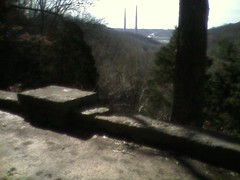
In my review of the Unforeseen Wilderness by Wendell Berry, I mentioned the entrance to Clifty Falls and the smoke stacks that made havoc of our lungs while we were there. The weather kept the clouds socked in low to the ground and the prevailing wind was straight from the stacks into the gorge. Yuck!

The Unforeseen Wilderness: Kentucky's Red River Gorge

The Unforeseen Wilderness: Kentucky's Red River Gorge, by Wendell Berry with photos by Ralph Eugene Meatyard. Shoemaker & Hoard, 1991.


I read this book back in April while on Spring Break with the family at Clifty Falls State Park (YouTube video of Clifty Falls) just west of Madison, Indiana. The book was a good and constant companion to the rocky cliffs, steep climbs, winding trails and waterfalls of the springtime park. The natural beauty accompanied by the words of Wendell Berry was a much needed respite. The book has the high quality writing that I've come to expect of Wendell Berry, not his best work by far, but appropriate to the physical setting and as always provocative in the best sort of way. The book was written to "save Kentucky's Red River Gorge from destruction"--i.e., to prevent the damming of the river and the drowning of the gorge--and that utilitarian motive (having been written for a useful purpose) casts a shadow and adds an artifice to the literary work that is rarely seen in Berry's poetry and fiction. That and the distance the book travels from Berry's usual topic--good land poorly farmed--makes for some dis-ease, at least for this reader.

Despite the minor criticism (that the book, though well suited to what it is, isn't what I had hoped or even as good as the greatest of Berry's works), the book offers descriptions and photos of the Red River Gorge that show it at its best (though I have never seen it). I imagine from Meatyard's photos and Berry's prose that it is the same sort of place that Clifty Falls once was, before Clifty Falls became overrun by the tourism (I was one of the tourists) that comes with the development of a place for "recreation," the establishment of a lodge and "easy trails" and paved roads along the gorge. Clifty Falls also suffers from having a coal fired power plant at its entrance, the stacks of which obscure the view and the smoke from which is enough to make even a healthy lung wheeze. (See the next post for the view from a cell phone camera.)

It is when the beautiful simplicity of the prose matches the austerity of what is described, the frugality of the words matching the extravagance of the "trout lilies, rue anemones, trailing arbutus" that Berry is at his finest. Those--and the places where he skewers the tourist-eye-view, regrets both the organizations that oppose and defend the dam, and that would destroy and preserve the gorge, and does battle with the likes of the mindset of the Army Corps of Engineers--are that places where the Wendell Berry we appreciate most comes into view.

Not the best book in the Berry bibliography. If you've never read Berry, don't start with this book. But if you are taking a tourist trip to see a "natural wonder" some day soon, pack this little reminder of sanity along. Oh the difference he'll make in the way you view the rocks and trees!

Friday, May 9, 2008

Salad Days!

We are eating high off the hog here at Tumbledown Farm.


From Cooking and E…

These May days are full of anticipation. About the only thing that hits the plate directly from the garden at the moment is lettuce.


From Broccoli

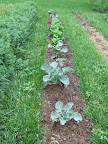
[Photo: A few mini-heads of Romain Lettuce / Paris White Cos sitting mid-way down a row of broccoli. Eating the whole bunch just before it forms the distinctive Romain lettuce center will give you a good substitute for iceberg. My family will not eat mesculun or any spring leaf lettuce mix because “it is bitter and it doesn’t crunch.” So, we have to plant what they’ll eat!]

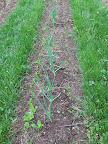
Maybe a few baby onions (or scallions) can be thrown in for good measure, but anything that did not over-winter or get a head start inside under the lights is still too small to eat!


From Onions
(Waiting, waiting, waiting for those first beets, radishes, some spinach, kale, kohlrabi, and the like.) Sometime later this month we’ll have more than we can eat. For now, though, we dine on a little bit of lettuce and onions. Next year I’ll learn how to use hoop supported row covers to begin planting about 10 days earlier. I want to be feasting from the garden by the first week of May!

Of course, there is always a little asparagus volunteering here and there. [The birds plant it for us. Got some new this year, sprouting beside the privet someone unwitting planted as an ornamental.]
And we’re eating some rhubarb.


From Rhubarb

This year I paid $9 at Menard’s for 3 sets of 3 very dead looking rhubarb roots (9 altogether…that’s $1/root by my calculation) on the clearance shelf on the very last day they would sell it. I figured since Gurneys and the other mail order places charge $7.95 per root plus shipping, if even two of the roots showed signs of life I would be ahead. …and just look what happened!


From Rhubarb


From Rhubarb

The bacon was purchased at regular (inflated) market prices. (Maybe with just an acre more?…) But the free-range eggs for our lunch-time omelet were provided by a friend. Sometimes it just pays to be a Tumbledown Farmer!

Tumbledown Farm

Wednesday, March 12, 2008

Planting an Urban Farm: The Time Is Here

There has been an unrelenting flood of news about land prices lately–moving in opposite directions, up and down at the same time–the momentum and tempo of which has been steadily increasing:


1) Foreclosures and property abandonment in cities and suburbs are at an all time high, while prices for development property/lots and single-family housing are falling (Targeted: Housing Blight ; City to develop own plan to revive neighborhoods).


2) The value of farmland is also at an all time high (largest one-year jump in 30 years, Farmland prices continue to rise; from $3500 to $4000 per acre in the past two years, Grain boom may spark rural revival; Rising prices will boost state’s economy, but consumers will have to pay more for goods).


At the same time that the city is asking “What can we do with all those abandoned homes?” (Olgen Williams, Deputy Mayor for Neighborhoods, to Star reporter Ted Evanoff), farmers are looking for land to buy or rent. As the NYTimes reports, there is big competition for new farm acreage at a time when the rest of the economy seems to be in a tail spin: “[a]t a moment when much of the country is contemplating recession, farmers are flourishing.” The 7000 foreclosures and abandonments in the city of Indianapolis alone are resulting in decreased tax base, a shortage of affordable housing (ironically), health and safety issues, crime and squatting. It seems to me that a better quality of life in city neighborhoods could be had by turning abandoned property into farmland and gardens. The good news is that agribusiness will not be able to even park, much less use, the John Deere 630T, 530 hp, with its 330 gallon fuel tank, on a lot of .1 or .3 acres. Using those city lots for urban farms and gardens would require shovels, hoes, rakes and other sustainable equipment. With “inputs” (chemical fertilizers) doubling in cost this past year, there would probably be less temptation to overuse those too.


I think the confluence of these two economic forces presents an opportunity for the niche urban micro farm.


It seems that I am not alone in thinking this is a good solution to some of our most intractable problems. Purdue Extension-Marion County announced in January that it had received a $10,000 grant from the Efroymson Fund, a CICF fund, for a pilot Urban Farm Project. In addition to problems of urban blight, The Urban Farm Project will address food insecurity on the Indianapolis near-east side. (Not far from Tumbledown Farm.) The community that this urban farm project will serve lost its only neighborhood full-service grocery store in the spring of 2007. Area food pantries have been stretched beyond their limit to respond. (As is also the case in Johnson county.) According to the extension newsletter, The Urban Farm Project “will help provide fresh produce by planting chemical-free urban gardens on two or three vacant neareastside lots. The produce generated from these lot gardens will be donated to a nearby food pantry for distribution to the community’s needy.” At the same time, the project “will also be an apprenticeship program for local high school students.” What a combination! (For more info about the Indy Urban Farm, contact Matthew Jose, Urban Garden Program Asst.)


It seems to me that this sort of model might also work in the “for-profit” world. Muhammad Yunus, Creating a World Without Poverty: Social Business and the Future of Capitalism, may show us the way with his banker-to-the-poor ideas about doing good by doing well in a distributed, small-scale way.


With food prices rising because of the spike in the cost of agribusiness commodities, I have been thinking about expanding Tumbledown Farm, ever so slightly. There is a little 40X136 lot (oh, about .13 acres, not enough for the big guys to notice, return on investment too small and too slow) about 9 miles from us that is listed with MIBOR for $2500. I bet it could be had for $2,000 in cash, and in three years could be producing $500 per year in filberts. A soil test, a little manual labor, and all the hazelnuts you can eat. (Or, for a little more time and labor, strawberries or raspberries, or vegetables of all sorts.)


What think you? Time for an urban micro farm? Want a share in this little agricultural and sociological experiment?


Tumbledown Farm

Friday, February 15, 2008

The Good Life: Helen and Scott Nearing's Sixty Years of Self-Sufficient Living

The Good Life: Helen and Scott Nearing's Sixty Years of Self-Sufficient Living. Schocken Books, Inc., 1989.


This book is a combination of Living the Good Life (1954, 1970, 1982) and Continuing the Good Life (1979), with a new introduction by Helen Nearing. The first book is an accounting for 20 years (from 1932) lived in the backwoods of Vermont. The second book (bound in this instance together with the first) is an accounting from 1952 on of a similar experiment in living on a farm in Harborside, Maine (Cape Rosier). It is clear from the beginning that these are not "simple folk" forced into a simpler life of necessity (at least not physical necessity), but a couple who are seeking together a way of removing themselves from the larger society marked by World War and a rise in fascism to practice pacifism, vegetarianism, and collectivism. These are "professors" out to teach as much as they are to live well. They sought a life that would be 50% subsistence provision of their needs directly through their own physical "labor" and 50% "leisure" ("research, travelling, writing, speaking and teaching"). Obviously, their goals were more complicated than mine. I am simply interested in the parts of their experiment that show The Good Life to be also the sustainable, small-scale life, by which I mean something more like Duane Elgin's voluntary simplicity. (Voluntary Simplicity, Revised Edition: Toward a Way of Life That Is Outwardly Simple, Inwardly Rich) I am interested in their goal to eat from the work of their own hands, and to escape the traps of economic complicity in a high-consumption culture. I am less interested in the Nearings' social experiment (the collectivism), and more interested in their vegetable garden. My life is such that I'll not be able to escape the suburban landscape any time soon, so I'll not have the Nearings' 65 acres with which to experiment in living the good life. And even if I could, I would do it differently. The Nearings didn't keep animals for any purpose, especially not for eating, so I am loathe to call what they did traditional, small-scale farming. But I am interested in their techniques for subsistence "farming" without the use of chemical fertilizers or animals and animal products. (What?! No manure? Is it really possible to "improve" the soil without chemicals or animal manures?)

Should I ever be in the position to start from scratch on new land, I will certainly consult their chapters on building a house. And already, I have benefitted from their advice for extending the gardening year and for preserving garden produce. And almost they have persuaded me that vegetarianism is the way to go. Perhaps we should say that my farm will be less animal-intensive and animal centric for having read their work. But their chapters on living in community do little for me. I wonder whether they were simply too "serious" and "intentional" to recognize the community that already exists in churches, civic organizations, gardening organizations and the like. It seems to me that what they desired in the way of community was too confining, certainly for free-spirited Vermonters, but for anyone with a sense of individuality and independence. Though I do not go in for total withdrawal from society and complete self-sufficiency (undesirable and impossible), I do think that the indepence of spirit that marks citizens of the U.S. is a good thing that can be encouraged for the sake of many of the ideals that the Nearings embrace for living the good life.

In short, I recommend the book for its chapters on homestead buildings and construction, for its sections on gardening and diet, and for its overall spirit of voluntary living, its voluntary simplicity.