Showing posts with label farm industry. Show all posts

Monday, December 15, 2008

The Gift of Good Land


Wendell Berry's The Gift of Good Land: Further Essays Cultural and Agricultural is the 1981 publication (North Point Press, San Francisco) of a collection of essays hailing mostly from the 1970s, the environmental crises of which are a prelude to the same and similar questions now--and crises that have mostly only been exacerbated, not improved, by the passage of time.


It goes almost without saying that Wendell Berry's reputation as a thinker and writer was made by such essays and that the essays are well worth the reading, even now, for their obvious attention to the craft of writing. It is enjoyable, not just informative, to read Berry. This collection in particular was a followup to Berry's critically acclaimed The Unsettling of America, which is indeed where readers should start, if they haven't already, in reading Berry's work.


About the Essays:


"An Agricultural Journey in Peru" is a travel essay in the spirit of F.H. King's Farmers of Forty Centuries: Or, Permanent Agriculture in China, Korea and Japan. Instead of eastern traditional modes of farming, Berry focuses on what can be learned from traditional Peruvian potato farmers, especially what can be learned of preserving soil using terraces for hillside farming. The contrast between the traditional modes of preserving the soil and the methods promulgated by the "International Hill Land Symposium" (the subject of chapter 4) is obvious to Berry, and therefore also to the reader. Throw in such classics as "Horse-Drawn Tools and the Doctrine of Labor Saving" (Berry thinks labor saving leads to poor employment, as in a dearth of good work to do well.) or "Agricultural Solutions for Agricultural Problems" (i.e., industrial solutions to agricultural problems are no solutions at all) or "The Reactor and the Garden" (no, nuclear energy is no safer a bet now than it was when Berry first wrote the essay) or "A Good Scythe" (for anyone whose ears hurt after using a gas powered 'weed eater') and you've more than recovered the cost of the book.


Better yet, save some trees and check it out from your local library. I just returned it to ours for safe keeping. (I'm running out of shelf space.)


The book does include Berry's usual paeans to the Amish way of living. These are available elsewhere in many of Berry's non-fictional books. From Berry's own Foreword, the most compelling reason to read the book is for its presentation of many "exemplary practices" in farming and living. That's surely reason enough!

Monday, February 11, 2008

Gardening Economy and Non-Cooperation

A Gardening Economy: The Cost of Non-Cooperation


I’ve been reading a little too much of Mahatma Gandhi lately, especially his Freedom’s Battle: Being a Comprehensive Collection of Writings and Speeches on the Present Situation, which is available on the Kindle for $.99 (free on the internet). It struck me as I read again Gandhi’s advocacy of “non-cooperation” as an alternative to surrender or complicity, that non-cooperation may be our best and only option against the multinational agricultural corporations, the behemoth colonial powers of our day. Agribusiness requires our cooperation to survive. ADM and the others require our cooperation to maintain their near monopoly status. Their power is truly dependent on our continuous cooperation with them in the purchase of processed foods.
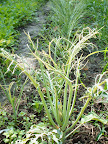


And unless I’m very much mistaken, gardening is truly our most natural and most effective expedient for refusing to maintain their rule. We must simply refuse our cooperation; withdraw it. We can start by reducing or eliminating processed foods from our diet and buying whole foods from local farmers. Some fear that, if we were to succeed (and they very much doubt that we will), this would produce the total collapse of the farm economy. But as Gandhi predicted of Indian self-government, long before there could be a total collapse, we would have forged strong ties with local producers and robust local means of distribution. Others protest that this sort of non-cooperation is a negative path, that it will destroy the cheap food on which our high standard of living is based. But, as Gandhi pointed out, non-cooperation with the multinational corporation means greater cooperation among ourselves and “greater mutual dependence.”


So, what will non-cooperation cost me this year? Besides some time and labor, it has already cost $77.20. (Watch the garden budget this year to see what I purchase and what the garden yields are. We’ll weigh everything as we harvest and record the value of the produce by comparison to the cost of fruit and vegetables at the local Meier Supermarket.)


Here’s what we’ve bought so far: Goliath Hybrid Pepper Seed (pkt-30, $2.60), Big Beef Hybrid Tomato Seed (pkt-30, $2.10), Early Girl Hybrid Tomato Seed (pkt-30, $2.20), Besweet 2020 Edible Soybean Seed (pkt-2 oz., $1.95), Red Ace Hybrid Beet Seed (pkt-300, $1.90), Super Blend Hybrid Broccoli Seed (pkt-200, $1.80, 33% each of Liberty, Pirate, and Major), Alchiban Hybrid Eggplant Seed (pkt-30, $2.00), Sweet Basil Seed (pkt-100, $1.50, Italian Large Leaf Basil), Long Standing Cilantro or Coriander Seed (pkt-100, $1.50), Kossak Giant Hybrid Kohlrabi Seed (pkt-50, $2.25), Paris White Cos Lettuce Seed (pkt-5 grams, $1.55, Romaine Lettuce), Evergreen Bunching Scallions Seed (pkt-250, $1.55, White Bunching Onion), Hungarian Yellow Wax Pepper Seed (pkt-25, $1.55, Hot Banana Pepper), Bloomsdale Long Standing Spinach Seed (pkt-7 grams, $1.50), Dwarf American Hazelnut Plant (4 plants, $18.50), Sparkle Strawberry (25 plants, $8.75), Nugget Hops Plant (1 plant, $8.25), Thuricide (8 oz concentrate, $8.25, Bacillus thuringiensis var. kurstaki), Early Bird Garden Tomato Seed (pkt-25, $0.00), Early Bird Garden Pea Seed (pkt-1 oz, $0.00, medium-vined garden pea variety), Early Bird Garden Cucumber Seed (pkt-25, $0.00, Fancy Green Slicer), Early Bird Garden Bean (pkt-1 oz, $0.00), Early Bird Garden Sweet Corn (pkt-1 oz., $0.00, hybrid yellow sweet). The last few, the ones labeled “early bird,” are “experimental varieties” included in the R.H. Shumway’s shipment as a reward for ordering early and ordering more than a minimal number of items. This year I bought the whole lot from Shumway. I’ll report later how their seeds and plants performed. Shipping was $7.50.


A few of these items require explanation. First, the Thuricide. I hate to put any sort of pesticide on the garden, but Bt appears to be, by every account, organic and environmentally friendly.


It has a very narrow use–the destruction of cabbage moth caterpillars–and will be used by me only to take care of extreme cases, where total vegetable loss is a possibility. Think I’m kidding? Look at the photos below of my first attempt a few years back to grow broccoli. And our family loves broccoli!


broccoli plant shredded by cabbage moth caterpillars


Another oddity is the hops plant. With the hops I intend to make my own dried yeast for bread baking. And, of course, Hazelnuts (or Filberts) are about the only nuts that can be grown on a small suburban lot and still allow room for all the strawberries, raspberries, blackberries, gooseberries and a vegetable garden! So, stay tuned, we have a lot of growing to do on this non-cooperative micro-farm in 2008!


Tumbledown Farm

Saturday, November 4, 2006

Farming, a Living or a Lifestyle?

According to the profundities of our agriculture professors, these days you can either have farming as a "way of life" or as a "living"--that is, either as a "lifestyle" or as a "profitable business"--but not as both. (Purdue's Michael Boehlje, "From Tractor Driver to Chief Executive," Indianapolis Star, October 29, 2006) Obviously, things have not always been this way. At the turn of the last century, it was assumed that "to a large extent" a farmer's livelihood--food and fuel, and other necessities for living--were taken directly by the farmer from the farm and not gained derivatively through cash from farming. "The country experience" and "rural values" were a part of the "good living" a farmer made, and "the money," 10%, amounted to a return on the farmer's cash investment (5% actual cash profit, if that). Another assumption was that a "farmer" was anyone who had agriculture as the "chief means of livelihood." ("A Good Living and 10%," How to Do Things, p. 254)


As a result, one of the fundamental rural values of 19th and early 20th century farmers was self sufficiency, another was independence. Those are lost to today's "full-time enterprise farm." As Beohlje says, now farmers--as CEOs of a profitable businesses--are contract suppliers who must follow specific production methods and meet targets and deadlines. Targets? Deadlines? Operating "machinery and equipment 24 hours a day"? Sounds like nothing short of slavery to Tumbledown. All the work and none of the lifestyle? Why not punch a clock or sit in an office, if the object is merely money?


Is it really impossible to earn a full-time living and still keep the farming lifestyle? According to the good professor, the full-time farm comprises "5,000 or more acres or 10,000 or more hogs"--and is "more a business than a way of life." According to the professor, some mid-size farm families "choose" to both farm and have an off-farm job. Even so, it is "technology" that allows these farmers to manage "1,000 acres or more." Tumbledown wonders whether working two jobs really leaves time for the farming lifestyle. And when the second job is a result of the "choice" between losing the farm or adding an off-farm job to support the farming "lifestyle," Tumbledown figures the professor should have said these farmers "are forced" to both farm and work an off-farm job. Even so, these mid-sized farmers do not keep it up long, as their decreasing numbers demonstrate. That leaves the "lifestyle" farmer, whose numbers are growing. Maybe we should call these farmers "farming reenactors," weekend preservers of a "lifestyle" that no longer really exists. Artificial farmers.


Tumbledown suspects that these "lifestyle" farmers sometimes do harbor dreams of farms that "warrant the entire attention of at least one [person]" (another assumption in How to Do Things).


According to the same Star article, "65 percent, or 15 million acres," of Indiana land is dedicated to farming today. At the time of the 1900 census, the number was 21,619,623 (out of the total area of 22,982,400) acres, or 94%. (Cyclopedia of American Agriculture) According to the 2005 USDA stats, the number of farms in Indiana today is 59,000--at the 1900 census it was 221,897. Today the average farm size is 254 acres, then--if Tumbledown's calculator works--it was 97. The only statistic that seems to move in a favorable direction is the total cash value of the "agricultural products"--$5.5 billion last year, $203 million in 1900.


Have we taken the farming "lifestyle" out of farming in favor of cash? Do we really prefer dependent city living as the paradigm and independent country living as the exception?


Tumbledown somehow has the same dream as Harvey Wiley (The Lure of the Land) did:


"Theoretically, my idea of humanity would be a scattered population, all of the productive industries taken out of the cities and place in the country to which they properly belong, and the city left only as a place of exchange. Meanwhile, let us make the best of things as they are. ...intend to be real farmers, to live upon the farm and gain [...] livelihood therefrom,--and by farm I do not mean simply fields of wheat and corn, but I mean orchards and dairies and gardens and forests, in fact all the various activities by means of which Mother Earth yields her treasures of grain and fruit and flowers to her tenants."


Or as Gene Logsdon says (from his lips to God's ears), "The Future: More Farmers, Not Fewer." (Living at Nature's Pace) More real, diversified farms. Don't call what Tumbledown does a hobby; it's a good way of living. Now if he could just make a little cash at it--maybe 10%?


Tumbledown Farm

Friday, October 13, 2006

Finger Prints on the Smoking Cow?

Yesterday Tumbledown learned that the FDA and State of California have now confirmed test-positive that samples of cattle feces gathered from a ranch some 2 miles from the farm where contaminated spinach was grown contains E. coli with "matching genetic fingerprints" for the same strain of E.coli O157:H7 that earlier sickened 199 people. Officials continue to caution against jumping to conclusions, but it is becoming more difficult to escape the obvious: the cow did it. With its poop print on the murder weapon, it'll be hard for the defense to make its case. The question for Tumbledown is now whether these were pasture-fed cows (doubtful) or whether they were cows of the grain-fed, manure-lagoon-producing type (more likely). It is encouraging to hear health officials admit that the growing history of "outbreaks linked to leafy greens indicates an ongoing problem," but Tumbledown is not sanguine that our state and federal officials will produce solutions that move beyond technological quick fixes. (See yesterday's post.) Not likely that nature's counterintuitive (to industrial agriculture) and permanent fix--to place more, diverse, animals (and more poop, more widely scattered) on farms that also grow a greater diversity of plants--will attract a following. After all, that would require farmers who are generalists and officials who are localists. And everyone today is a specialist and internationalist. And we like it that way. (Not T.!)

Wednesday, October 11, 2006

Will the Real Farmer Please Stand Up?

Tumbledown was incensed again to read Lew Middleton's comment that "Today's farmers are specialists, not generalists." (The Hoosier Farmer, Fall 2006, p. 1) When Middleton went on to claim that such specialization is "all aimed at creating the safest" and "healthiest" environment for the livestock, Tumbledown nearly let loose an expletive. Specialization is driven by corporate insatiability, by the profit motive. Specialization in livestock farming is not "friendly to the environment." It is the most likely source of the E. coli in our spinach, just ask Michael Pollan. (Op ed in today's NYT Magazine, "The Vegetable-Industrial Complex," joined a growing chorus of people who are refusing to ignore the obvious.) Pollan quotes Wendell Berry's old saw that we have taken nature's elegant solution in which "crops feed animals and animals’ waste feeds crops" and, by becoming specialists in either crop production or animal production (but never proficient in both), we have turned nature's solution into two very real problems: "a fertility problem on the farm, and a pollution problem on the feedlot."


The solution that is eventually proposed for our E. coli problem is not likely to be a real solution (that is, a radical solution, that fixes the root problem of specialization) like nature's solution, but a technological quick fix, like the "high-tech" agriculture touted in the most recent Hoosier Farmer. (The irony is, of course, that the magazine cover sported dairy cows on pasture, not beef cattle and sows in confined operations.) At any rate, Pollan is right, look for the politicos and their trough-filling K-street fat cats to start touting programs to irradiate the entire food supply. Don't look anytime soon for a return to real farms where everyone raises, "some corn, some wheat, some soybeans, a few milk cows, a few pigs, maybe some beef cows. And, of course, a big garden to help feed a growing family." (Hoosier Farmer)


Tumbledown did get a little good news this week in the story about Denise O’Brien, the organic farmer and Democratic candidate to become Iowa's secretary of agriculture. Denise is a real farmer. For Iowa's sake, and for ours, Tumbledown is praying that she wins.

Saturday, September 23, 2006

No Real Farmers

On the heels of yesterday's news about the likely source of the E. coli outbreak--manure lagoons from massive dairy and cattle operations (see previous post)--Tumbledown learned today that "real" farmers (the "janitors in confinement barns") are about to increase their presence in the "industry" again, as Smithfield Foods buys Premium Standard Farms. (NYTimes editorial, September 23, 2006, "The Ultimate Efficiency") Independent farmers, already squeezed, are about to have even fewer places to market their hogs. It may seem a small thing that pigs are no longer slaughtered and butchered close to home, where both the farmer and butcher are resident members of the community who will eat the pork. And it may seem that the threats to food safety from producer consolidation (single source) and massive warehousing of animals can be managed and regulated. But regulations to "protect our health" make it extremely difficult for the small farmer or butcher to stay in business, and in effect the regulations that now exist simply "protect the wealth" of the large corporations. Every effort should be made to encourage local production (raising and packaging) of food. Regulation should be simplified and compliance made easy for local producers. We had monopolies once, to very grave effect. Why would we want to travel that road again?