Showing posts with label gardening. Show all posts

Friday, May 9, 2008

Salad Days!

We are eating high off the hog here at Tumbledown Farm.


From Cooking and E…

These May days are full of anticipation. About the only thing that hits the plate directly from the garden at the moment is lettuce.


From Broccoli

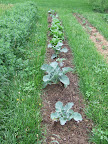
[Photo: A few mini-heads of Romain Lettuce / Paris White Cos sitting mid-way down a row of broccoli. Eating the whole bunch just before it forms the distinctive Romain lettuce center will give you a good substitute for iceberg. My family will not eat mesculun or any spring leaf lettuce mix because “it is bitter and it doesn’t crunch.” So, we have to plant what they’ll eat!]

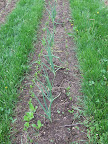
Maybe a few baby onions (or scallions) can be thrown in for good measure, but anything that did not over-winter or get a head start inside under the lights is still too small to eat!


From Onions
(Waiting, waiting, waiting for those first beets, radishes, some spinach, kale, kohlrabi, and the like.) Sometime later this month we’ll have more than we can eat. For now, though, we dine on a little bit of lettuce and onions. Next year I’ll learn how to use hoop supported row covers to begin planting about 10 days earlier. I want to be feasting from the garden by the first week of May!

Of course, there is always a little asparagus volunteering here and there. [The birds plant it for us. Got some new this year, sprouting beside the privet someone unwitting planted as an ornamental.]
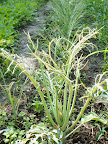
And we’re eating some rhubarb.


From Rhubarb

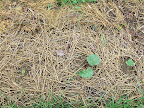
This year I paid $9 at Menard’s for 3 sets of 3 very dead looking rhubarb roots (9 altogether…that’s $1/root by my calculation) on the clearance shelf on the very last day they would sell it. I figured since Gurneys and the other mail order places charge $7.95 per root plus shipping, if even two of the roots showed signs of life I would be ahead. …and just look what happened!


From Rhubarb


From Rhubarb

The bacon was purchased at regular (inflated) market prices. (Maybe with just an acre more?…) But the free-range eggs for our lunch-time omelet were provided by a friend. Sometimes it just pays to be a Tumbledown Farmer!

Tumbledown Farm

Monday, February 11, 2008

Gardening Economy and Non-Cooperation

A Gardening Economy: The Cost of Non-Cooperation


I’ve been reading a little too much of Mahatma Gandhi lately, especially his Freedom’s Battle: Being a Comprehensive Collection of Writings and Speeches on the Present Situation, which is available on the Kindle for $.99 (free on the internet). It struck me as I read again Gandhi’s advocacy of “non-cooperation” as an alternative to surrender or complicity, that non-cooperation may be our best and only option against the multinational agricultural corporations, the behemoth colonial powers of our day. Agribusiness requires our cooperation to survive. ADM and the others require our cooperation to maintain their near monopoly status. Their power is truly dependent on our continuous cooperation with them in the purchase of processed foods.


And unless I’m very much mistaken, gardening is truly our most natural and most effective expedient for refusing to maintain their rule. We must simply refuse our cooperation; withdraw it. We can start by reducing or eliminating processed foods from our diet and buying whole foods from local farmers. Some fear that, if we were to succeed (and they very much doubt that we will), this would produce the total collapse of the farm economy. But as Gandhi predicted of Indian self-government, long before there could be a total collapse, we would have forged strong ties with local producers and robust local means of distribution. Others protest that this sort of non-cooperation is a negative path, that it will destroy the cheap food on which our high standard of living is based. But, as Gandhi pointed out, non-cooperation with the multinational corporation means greater cooperation among ourselves and “greater mutual dependence.”


So, what will non-cooperation cost me this year? Besides some time and labor, it has already cost $77.20. (Watch the garden budget this year to see what I purchase and what the garden yields are. We’ll weigh everything as we harvest and record the value of the produce by comparison to the cost of fruit and vegetables at the local Meier Supermarket.)


Here’s what we’ve bought so far: Goliath Hybrid Pepper Seed (pkt-30, $2.60), Big Beef Hybrid Tomato Seed (pkt-30, $2.10), Early Girl Hybrid Tomato Seed (pkt-30, $2.20), Besweet 2020 Edible Soybean Seed (pkt-2 oz., $1.95), Red Ace Hybrid Beet Seed (pkt-300, $1.90), Super Blend Hybrid Broccoli Seed (pkt-200, $1.80, 33% each of Liberty, Pirate, and Major), Alchiban Hybrid Eggplant Seed (pkt-30, $2.00), Sweet Basil Seed (pkt-100, $1.50, Italian Large Leaf Basil), Long Standing Cilantro or Coriander Seed (pkt-100, $1.50), Kossak Giant Hybrid Kohlrabi Seed (pkt-50, $2.25), Paris White Cos Lettuce Seed (pkt-5 grams, $1.55, Romaine Lettuce), Evergreen Bunching Scallions Seed (pkt-250, $1.55, White Bunching Onion), Hungarian Yellow Wax Pepper Seed (pkt-25, $1.55, Hot Banana Pepper), Bloomsdale Long Standing Spinach Seed (pkt-7 grams, $1.50), Dwarf American Hazelnut Plant (4 plants, $18.50), Sparkle Strawberry (25 plants, $8.75), Nugget Hops Plant (1 plant, $8.25), Thuricide (8 oz concentrate, $8.25, Bacillus thuringiensis var. kurstaki), Early Bird Garden Tomato Seed (pkt-25, $0.00), Early Bird Garden Pea Seed (pkt-1 oz, $0.00, medium-vined garden pea variety), Early Bird Garden Cucumber Seed (pkt-25, $0.00, Fancy Green Slicer), Early Bird Garden Bean (pkt-1 oz, $0.00), Early Bird Garden Sweet Corn (pkt-1 oz., $0.00, hybrid yellow sweet). The last few, the ones labeled “early bird,” are “experimental varieties” included in the R.H. Shumway’s shipment as a reward for ordering early and ordering more than a minimal number of items. This year I bought the whole lot from Shumway. I’ll report later how their seeds and plants performed. Shipping was $7.50.


A few of these items require explanation. First, the Thuricide. I hate to put any sort of pesticide on the garden, but Bt appears to be, by every account, organic and environmentally friendly.


It has a very narrow use–the destruction of cabbage moth caterpillars–and will be used by me only to take care of extreme cases, where total vegetable loss is a possibility. Think I’m kidding? Look at the photos below of my first attempt a few years back to grow broccoli. And our family loves broccoli!

broccoli plant shredded by cabbage moth caterpillars


Another oddity is the hops plant. With the hops I intend to make my own dried yeast for bread baking. And, of course, Hazelnuts (or Filberts) are about the only nuts that can be grown on a small suburban lot and still allow room for all the strawberries, raspberries, blackberries, gooseberries and a vegetable garden! So, stay tuned, we have a lot of growing to do on this non-cooperative micro-farm in 2008!


Tumbledown Farm

Wednesday, January 23, 2008

Planning the 2008 Garden

It appears that I’ll be a Master Gardener eventually. But for now, I’m just an intern, donating the occasional day to worthy gardening causes and learning as I volunteer about other people’s garden questions in a hands-on, dirt-turning setting, but with the help of those who have been at this much longer. At any rate, I passed my MG test back in December, so I guess that means I can mostly be trusted not to kill too many plants.


2008 Garden Catalogs


But enough of all that. Time’s-a-wasting, and the 2008 gardening catalogs are on the table and I’m anxious to use some of what I’ve learned. It’s time to plan the 2008 garden! Stay tuned for the next few weeks and I’ll tell you what I ordered and why…and what it cost and I’ll post the photos as the seeds begin to sprout. You may notice this year that I’ve gone mostly for hybrids with a few heirlooms to supplement the lot, rather than plant all heirlooms. Why? Because I’ve begun to think that Integrated Pest Management (IPM) makes a heck of a lot of sense. That doesn’t mean that I’ll begin using a lot of chemical pesticides or go gangbusters with chemical fertilizers; it just means that I’ll pay attention to the disease resistance of some hybrids as one of many tools to use in a balanced way in the garden. We’ll see how it goes and I’ll let you know what I use and when and most importantly WHY and what precautions I’ve taken. And we’ll see whether you think I’ve jumped on the industrial production, super-veggy bandwagon.


I’ll not stop using organic methods, especially composting and crop rotation and the like. These just make sense. In fact, the research just keeps getting stronger. Take my strawberry patch, for example. I’ve been using a rotation for several years that was suggested by Gene Logsdon that includes corn in the rotation. However, this year I’ve discovered that broccoli planted in the rotation prior to strawberries leaves a natural fungicide (glucosinolate) that keeps verticillium in check. (Krishna Subbarao, University of California, plant pathologist; see Organic, Inc.: Natural Foods and How They Grew, Samuel Fromartz)


Our family loves broccoli, so guess what we’ll plant instead of corn in that strawberry rotation for 2008? It never hurts to try a little experimenting of our own, especially the edible kind.


While you are planning your own garden, check out our new Indianapolis Gardening Calendar. I think you’ll like it.


Tumbledown Farm

Thursday, September 27, 2007

Master Gardener Class Begins

Is it possible to turn a Tumbledown Farmer into a Master Gardener? I guess we’ll find out.


Purdue Master Gardener Notebook


Tumbledown paid his $95 and is taking his chances. This past Tuesday, he spent all day in class at Purdue Extension-Marion County learning all he could about “plant science” and “horticulture” and “entomology” and “insect pests” and “weeds.” We began class with a pretest, which Tumbledown almost certainly flunked. The day then followed with lecture, aided by PowerPoint outline, photos, and physical examples (field samples). So far the experience is both exhilarating and daunting. If you enjoyed High School biology and wanted to go deeper, and if you love gardening, this may be the place for you. Tumbledown will keep you posted about what he’s learning and how it is going. If there are veteran Master Gardeners out there who would like to share their advice and experiences with Tumbledown readers, just register with the blog (see the link on the side bar) and leave us a comment. Share a note of encouragement or a note of caution, whichever fits.


Wondering what the Master Gardener Program is all about? Check out the Purdue Extension-Marion County Master Gardener page. Have a gardening question? E-mail it for an answer to the Master Gardeners who are standing by at marionmg@purdue.edu. Or call 317-275-9292.


There is a moral dilemma for Tumbledown, of course, given his natural suspicion of government programs and industrial agriculture (pesticides, chemical fertilizers, and the like). It is clear from day one (and from the agreement potential Master Gardeners are required to sign in order to enroll) that the course will include information about the proper use of pesticides and fertilizers, and to provide that information at the conclusion of the course to those who ask questions about how to garden.


Tumbledown has decided that he will take the Master Gardener course with his eyes wide open, hoping to discern where the information provided by the Extension Service educator can be used within the context of traditional (late 19th, early 20th century), diversified, sustainable small farms and gardens. He’ll take notes and report about those aspects of the course that tend to support and exhibit indebtedness to industrial agriculture and those that tend to support local, small farms.


Already it is possible to see some of the biases that so annoy Gene Logsdon and Wendell Berry. For example, the whole program falls under the rubric “Consumer Horticulture” (the only recognized alternative being “Commercial Agriculture”). Commercial ag produces; consumer ag consumes. Thus the economic engine revs. Still, the overall impression after the first day is of an Extension program with significant balance, able to hear and respond to the criticisms that have been leveled at it for some time. Not always altogether fair in its assessment of some “traditional wisdom,” but less strident in its opposition, and more willing to consider “organic” and biological controls than Tumbledown thought the purveyors of un-sustainable industrial agriculture might be.


Tumbledown will be listening to hear whether the things being taught are able to be fit into an emphasis on “genetic diversity, local adaptation, and conservation of energy.” (Berry, The Way of Ignorance) Tumbledown will be listening, in short, to improve his bottom line (the improvement of his garden.

Tumbledown Farm

Tuesday, January 23, 2007

Sowing Seeds, Spreading Manure

"Very truly, I tell you, unless a grain of wheat falls into the earth and dies, it remains just a single grain; but if it dies, it bears much fruit. Those who love their life lose it, and those who hate their life in this world will keep it for eternal life.” (John 12:24-25 NRSV)

“So therefore, none of you can become my disciple if you do not give up all your possessions. Salt is good; but if salt has lost its taste, how can its saltiness be restored? It is fit neither for the soil nor for the manure pile; they throw it away. Let anyone with ears to hear listen!" (Luke 14:33-35 NRSV)


Tumbledown recalls these words of Jesus as he looks through brightly colored seed catalogs on gray days in January and February. In fact, he is behind on such thinking this year. The seed order ought to be in the mail by now. Soon, even in Indiana, it will be time to start the tomatoes and peppers inside under the lights to give them a head start on summer. This year the Burpee catalog sports the New Porterhouse Beefsteak Tomato, “sure to beat any record in the neighborhood.” (But I’ll bet Burpee never went up against any real tomato growers. The tomato competition is fierce in this neck of the woods.)


The picture on the cover is of bright red, perfectly shaped, 4 lb. tomatoes. These purveyors of seed know better than to put pictures of the shriveled up seeds on the cover. They are selling us the plump and juicy fruit at the apex of life, even though it is the tiny dry seed that will arrive in our mailbox. Tumbledown always seems to buy more seed than he can possibly use, because he is sold on these pictures of its potential. His eyes are bigger by far than his garden. But he also never plants quite enough of the seed he over-buys. Sometimes seed packets go unopened, unused. Sometimes they keep until next year, but mostly they must be discarded, lifeless, the potential for 4 lb. tomatoes wasted. Better--even in a Tumbledown garden, where not much reaches its full catalog potential--to put the seed in the ground than to keep it sitting on the shelf.


There is another substance coveted by gardeners that works the same way. Tumbledown gets his from a farmer friend. Tumbledown's mother-in-law reminded him of it this Christmas with a famous quote by Thornton Wilder from “The Matchmaker,” “Money is like manure; it's not worth a thing unless it's spread around encouraging young things to grow.” (Actually, my mother-in-law attributed the quote to the title character of “Hello, Dolly!” … but from Wilder the quote sounds more literary and highfalutin.) The quote has also been famously attributed to the likes of Francis Bacon and John Paul Getty, who may have had a nodding acquaintance with the attributes of money. Whoever said it, the quote is widely used, so the resemblance must be remarkable. The quote is usually concluded—usually by a politician—with the comment that manure, if piled up in one place, just stinks to high heaven.


I doubt that Burpee sells much manure, but if they did, they would probably try to sell it like they do their seeds, with pictures of ripe red berries and tomatoes.


You’ve often heard what Jesus said about seeds and manure piles, and about money. But mostly Jesus was talking about life—his and ours. To convince us, he reminds us of the “much fruit” that will result from our death. Better to spread the wealth and lose our own life, better to plant the seeds and watch another generation of green things grow up, than to leave the seeds to sit on the shelf and store up the manure in stinky piles.


Now, where did I put that order form?


Tumbledown Farm