After years of reading Gene Logsdon's paeans to Amish economics, traditional culture and community ethic, Tumbledown decided he just had to experience Holmes County, Ohio for himself. So Tumbledown and his significant other (Mrs. Tumbledown) made their way in early August to the edge of the "epicenter of the largest concentration of the Amish in the world," the town of New Bedford in Coshocton County, Ohio ("A Horse-drawn Economy" in Living at Nature's Pace: Farming and the American Dream
While on this pilgrimage to examine the way one community has put real world clothes onto ideal commitments (to God, family, and land), Tumbledown read the following books that he commends to anyone interested in learning more about the Amish way of life:
Amish Society
Great Possessions : An Amish Farmer's Journal
A History of the Amish, Revised and Updated!
In addition, Tumbledown discovered the following resources for Amish products, services, and news:
First and foremost, The Budget, a newspaper established in 1890 that serves the Sugarcreek area (in its local edition) and (in its national and international edition) the Amish and Mennonite communities throughout the Americas. The rest are all a distant second to The Budget, including Country Roads and City Streets (The Times Reporter), and The Vendor (Green Valley Printing, 33477 SR206, Brinkhaven, OH 43006. 330-276-6508).
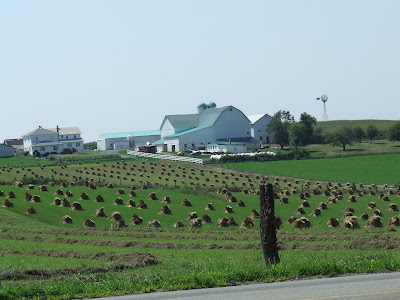
As you might expect him to, Tumbledown took special notice of the small farms (usually 100 acres or less, because the energy for their motive power comes from the sun in the form of horses), diversified farms [in the famous lines of Sir Albert Howard, An Agricultural Testament (Special Rodale Press Edition)
 |
| From Ohio Amish Co... |
It was especially gratifying to see horse-drawn mowers and balers in the hay fields, and to see up close how shocks of wheat are left to dry before being loaded onto carts and hauled away for threshing and winnowing. To see a living, thriving community where these skills (and tools) are being used on a daily basis gives Tumbledown some hope that we, "the English," will go to school on another, more sustainable, way of working and living--and that there will be Amish sources for much-needed, newly manufactured hand tools and horse-drawn machinery when the time comes to seek them out.
 |
| From Ohio Amish Co... |
 |
| From Ohio Amish Co... |
 |
| From Ohio Amish Co... |
Tumbledown was impressed with the selection of ingredients for cooking (this is Whole Foods, whole grains, fresh produce and the like, but without the industrialized baggage of the suburban chain store) available at the ubiquitous farm-based bulk food stores and the road-side and farm stands. But Tumbledown also noticed what most tourists to Amish Country see first, a thriving culture for the learning and producing of traditional arts and crafts, an artisans' community of hand-made household items like quilts and brooms and furniture. These are home-based "factories," in the old sense of places where things are made. Thus farmers and other "producers" live and work side by side, with gardens and barns and fields at small, irregular intervals between them.
And, of course, Tumbledown noticed all the buggy and wagon and bicycle traffic. That's what creates, even for the visitor, a slower pace to life. The refusal to own and operate cars for regular transportation is a key to the difference that we all notice as we drive our cars through Amish country. There are other keys, the lack of connection to "the grid," the limitation of education to the basics of the 8th grade, and a willingness to abide by a communal code of dress and mode of living.
But despite the attractions, nagging questions remain to be answered for Tumbledown. Can similarly sustainable communities be established and continue that exhibit a diversity of religious commitments (or no religious commitment at all) as opposed to what appears to be an Amish "religious monoculture" (or a sodality of religious monocultures)? Can a traditional community be established without hierarchical (and, specifically patriarchal) structures prevailing to the detriment of half the population? One might argue that such a community could evolve if many individuals (or nuclear families) were to choose independently to embrace such a mode of living with their own personalized rules or "orders," but it is precisely the lack of extended family and community support (and enforcement, or at least reinforcement) for such decisions and help with and provision of the models and tools for such living that are sorely lacking. Families and individuals could make these decisions perhaps, if there were communities of support already, but it seems problematic in the extreme to consider the formation of such communities where they do not already exist. Dropping out of the larger society is not exactly community formation. One can only hope (and Tumbledown does) that the ease of community-formation in cyberspace will enable us to put localized flesh-and-bones on new trial communities that aim at a new (old) way of living.
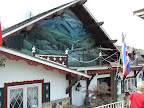
Can the community continue to outrun the pursuit of "development" and higher land prices? Can the community survive the onslaught of kitsch and commodity-fication of their own culture?
 |
| From Ohio Amish Co... |
(e.g., the Guggisberg cheese factory tells its story of Amish farmers bringing their milk to the back door in buggies [?], cheese that is available at the local Indianapolis Meier store in the dairy case in the produce section. It surely came to Indy in a refrigerated diesel truck.)
 |
| From Ohio Amish Co... |
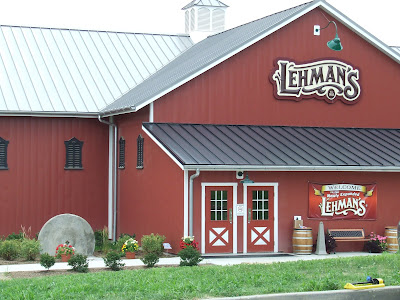
Will the Amish remain true to their values and continue their beneficial engagement with and witness to the industrial society that surrounds them? Tumbledown was somewhat dismayed to find that one of his favorite mail order catalog stores, Lehman's, was in fact playing an ambiguous role in mediating the values of the Amish (and traditional living) while at the same time very much playing up the tourist destination that it has become, restaurant and Wal-Mart mall-sized "mom-and-pop hardware store" included. Some of the products in the store were disappointing and seemed more designed for dress-up, play-time traditional rather than for the rough and tumble of real-world manual labor.
 |
| From Ohio Amish Co... |
On the way home to Indy, Tumbledown stopped at the site of another "traditional" manufacture, the Longaberger basket factory and company headquarters. Again he marveled at the expensive prices on largely ornamental and nostalgia-inducing items. Can hand-crafted quality be had ever again without the boutique price and Disney-theme-park-ification? Just give me a good, strong, hand-made working basket without the smell of potpourri or the premium charged for the boutique experience. Couldn't we all use a good basket rather than the plastic carriers we've learned to hate, then break with light use, then throw away? Give me something to feel good about gathering garden produce in, something that can take some abuse outdoors and still be in use a generation or two from now. And do it without charging enough to keep this corporate monstrosity afloat.
 |
| From Ohio Amish Co... |
I guess I'll be searching The Budget for an Amish basket maker in Indiana, someone whose workshop is steps from home, and garden, and barn.
Tumbledown would be remiss if he were to close the post without thanking his hosts, Dan and Nancy Lembke, program directors for A Valley View Inn, part of the Pastors Retreat Network. If you know a pastor who could use a week of spiritual renewal in Amish country, point the pastor and spouse to www.pastorsretreatnetwork.org. The stay is free for pastors (and spouses) in full time Christian ministry. The food is great (and Amish) and the leaders wonderfully down to earth (but also also spiritually minded). The library of Christian resources for ministry is strong and well focused for a week of retreat. Do your pastor and your congregation a favor by telling your pastor about this opportunity for spiritual rest and renewal.
 |
| From Ohio Amish Co... |

