Monday, September 24, 2007

Human Limits and Unlimited Hubris

Wendell Berry. The Way of Ignorance: And Other Essays, Shoemaker & Hoard, 2005. (contributions by Daniel Kemmis and Courtney White)


Collections of essays are never as tightly constructed or coherent as a reader might wish, but this is one of those rare cases--and rare authors--for which one can truly say it does not matter. The subject of human limits--and our need to recognize and honor those limits--is of such importance and so permeates every essay in the book that the reader forgives what disjunctions do occur between individual essays. There is not a linear progression from beginning to end, but in the end who cares. The subject has been addressed thoughtfully from many directions.

Part I is the least satisfying section of the book. It is also the most political (in the stupid sense of that word), but short enough to be tolerable. Berry has written more and better about "Contempt for Small Places" and "Rugged Individualism." Tumbledown was gratified to see Berry endorse the growth of farmers markets, community supported agriculture (CSAs), sustainable agriculture, Slow Food (using all of the "movement" monikers) and the like as an alternative to "competing on the global market" and as an indicator that indeed "We Have Begun." The pace picks up toward the end of this section with one good (Compromise, Hell!) and one better ("Charlie Fisher") essay. The latter, the story of a man logging and using horses to do it, is vintage Berry.

Part II is the reason to buy the book, 98 work-horse pages in 8 little essays. The first, "Imagination in Place," tells us that Berry is a farmer-writer and a writer-farmer, and that both vocations are shaped by (and shape) the land on which he lives. A wondrously brief bibliography (library) illustrates the shape of Berry's "philosophy" of farming:

F. H. King, Farmers of Forty Centuries: Organic Farming in China, Korea, and Japan

Sir Albert Howard, An Agricultural Testament (Special Rodale Press Edition)

Sir Albert Howard, The Soil And Health: A Study of Organic Agriculture (Culture of the Land: A Series in the New Agrarianism)

J. Russel Smith, Tree Crops: A Permanent Agriculture (Conservation Classics)

Aldo Leopold, A Sand County Almanac

If these have influenced Berry's thoughts, you can bet they'll be on Tumbledown's shelf and on his nightstand soon. How better to understand Berry's influence on my own thoughts than to read his sources (in the sense of wells and springs) independently.

The title essay, "The Way of Ignorance," first written as a conference paper for the Land Institute, Marfield Green, Kansas, is about "our old friend hubris, ungodly ignorance disguised as godly arrogance. Ignorance plus arrogance plus greed sponsors 'better living with chemistry,' and produces the ozone hole and the dead zone in the Gulf of Mexico." The thesis is that there is a congenital human ignorance and a a willful ignorance of our own ignorance (theologians would speak of original sin) that makes one shudder at the thought that our response to global warming and exhaustion of fossil fuels will be to build many, many more nuclear reactors. Having seen what gets "skipped" or "done poorly" at too many construction sites, Tumbledown has to agree that nuclear physics "'applied' by ignorant arrogance resembles much too closely an automobile being driven by a six-year-old boy or a loaded pistol in the hands of a monkey." All of that is on the first page of this dynamite essay that rings the changes on what we don't (and can't) know and why we should respect our limits. "The Purpose of a Coherent Community" is mostly a lament that we no longer have one. "Quantity vs. Form" is another demonstration that we transgress our limits at our peril--at the peril of appropriate human scale and a propriety of technological application. Medicine should be practiced by human standards (not by the standards of what machines can do). The same goes for agriculture. Limitless production is not a good thing. Limits provide the "formal completeness, grace, and beauty" of a part related to the whole. "Renewing Husbandry" is again a caution against boasting of "technological feats that will 'feed the world.'" Husbandry, according to Berry is the more comprehensive term; science the narrower, more specialized term. (Husbandry includes science.) Yet more is claimed for the much narrower science than the more comprehensive husbandry would ever dare claim. "The Burden of the Gospels" was of special interest to Tumbledown (a professional interest). It is heartening to see such straightforward readings of Scripture--especially the rejection of interpretations that come "perilously close to 'He didn't really mean it'" (Luke 14:26).

Part III consists of a letter by Berry to Daniel Kemmis (former Minority Leader and Speaker of the House in Montana, and mayor of Missoula), a reply from Kemmis to Berry. Both essays are worth reading if readers already care about the Democratic Party. If not, don't bother. The best essay of this final section is Courtney White's "The Working Wilderness: A Call for a Land Health Movement." Courtney is not predictably on any side except the side that offends both ranchers and environmentalists (and therefore probably best protects the land).

All in all, an awesome read. A book to read a second time (or at least major sections of it). A book to provoke thought. (And shouldn't every book be that?)

Monday, September 17, 2007

100 Mile Diet: Food for Thought


Tumbledown's summer reading list had a lot to do with eating. It began with Barbara Kingsolver's recounting of her family's year of eating locally (with help in the telling from her husband Steven L. Hopp and daughter Camille Kingsolver). The strength and also the weakness of the book was ease of reading. The access point for entry was the lowest common denominator of mass market appeal. But that also makes for good summer beach reading. (Not that Tumbledown went to the beach this summer, and had he gone, this book would have compounded his sense of guilt for having used the fuel and for having eaten his share of industrial fast food along the way.)

Kingsolver recounts what is becoming a popular and oft repeated experiment in eating (living, really), in which a person or couple or family decides to feed themselves food "from so close to home, we'd know the person who grew it." (p. 10) The recipes for that year-long experiment, many of which can be had for free at the Animal, Vegetable, Miracle web site, are worth the price of the book. (Also available at that site is an index of non-Kingsolver web sites and other online resources, many of which are also listed in the various chapters of the book.) Tumbledown's family especially appreciates the new "Friday night pizza" ritual that grew out of the chapter entitled "Six Impossible Things Before Breakfast." We are now imitating Kingsolver's example--and the fun of gathering the family around the table to put together our two 12" masterpieces of gustatory delight has become a weekly event likely to be repeated every week until the children leave the nest. The ingredients for our pizza toppings come fresh from the garden on the day we eat them, washed and chopped minutes before they hit the crust. The children see the journey from garden to mouth and participate fully along the way. Thanks to Kingsolver for the recipe and the suggestion that "family night" include food preparation and conversation about the sources of what we put in our mouths.

The final criticism, if indeed that is what it is, would be that sometimes the book comes across as "preachy." But that too is OK in a sermon, even one about the evils of Concentrated Animal Feeding Operations (CAFOs, where animals are confined in feedlots), the fuel cost of transporting food across the nation and across the world, and the broken economics of farming.


If Kingsolver's book is preachy, Pollan's book, The Omnivore's Dilemma, is pedantic ("teachy" in the monotone professorial sense) and inflammatory (referring in part to his attention-grabbing accusation that McDonald's McNuggets have as an ingredient tertiary butylhydroquinone (TBHQ), "a form of butane (i.e., lighter fluid)" (p. 187). Subtitled " A Natural History of Four Meals," the book is a Jeremiad (OK, he does sermonize) against monocrop corn and soybeans and (you guessed it) CAFOs. The four meals are 1) Industrial Food, 2) Pastoral Food: Whole Foods / Big Organic, 3) Pastoral Food: Small Organic, diversified and local, 4) Personal: Hunter / Gatherer. Many of the same concerns that animate Kingsolver's experiment also inform Pollan's work, which was published a year before Kingsolver's. And Pollan, for all his story-telling ability, also likes to pack the chapters with data and citations. Pollan's telling of the history of the organic movement and description of the differences between the new "industrial organic" and the more sustainable organic of smaller farms is a tribute to good research and writing. And the basic premise, the "omnivore's dilemma" about what to eat (because an omnivore cannot eat just the leaves of a eucalyptus) is robust enough to bear the explanatory weight of the book. Overall, very well done, despite some well-publicized controversy over some of the data. (But in a book that seeks to influence as well as inform, the overreaching of a datum or two is to be expected.)


Another book that partakes of what Pollan calls an "edible conceit" (an artificial set of rules for eating--a hyper-cultivation of a convention--for the sake of the art, in this case a book, and that moves well beyond what the author would naturally do), is the book Plenty: One Man, One Woman, and a Raucous Year of Eating Locally. It too tells the story of a year-long experiment in eating by one couple. Smith and MacKinnon's one "ironclad" rule was that "every product we bought had to come from within 100 miles." The point of the conceit, then, was "to explore, and explore deeply, the idea of local eating." (pp. 10-11) Unlike Kingsolver's and Pollan's books, which are experiments that feature the culture and foods of the Midwest and Southeast, Smith and MacKinnon's "local"-ity is foreign to Tumbledown. They live on the West Coast, the Pacific coast, west of the Cascades, in a land of mild winters and lots of rain. For that reason, the book was of interest conceptually, but hardly as informative for purposes of imitation. Still, it was an inspiration to read the story of this "conceit" and contemplate such a journey for ourselves. Just where would a family in Indianapolis draw the line on buying local food? In the flat Midwest corn belt, is local the Ohio border? (100 miles) Chicago? (200 miles) or Des Moines? (500 miles) ...or could it be that the circle around Indianapolis could be drawn more closely?

Why bother? That's the question asked once again toward the end of Plenty. The answer, in part, is the same in each of the above-mentioned books, because the average food item travels 1500 miles from farm to plate in North America. And, as Pollan says, along the way, it "has come to require a ramarkable amount of expert help" to determine where its origins are. "How did we ever get to a point," Pollan asks, "where we need investigative journalists to tell us where our food comes from...?" How indeed?


If you and your family are thinking of embarking on one of these "edible conceits," Tumbledown thinks you'll need a new cookbook for eating what's fresh and local when it is in season. (Don't look for fresh raspberries in Indianapolis in December!) The best one Tumbledown has seen is Simply in Season. It is a sequel to the much-loved More-with Less, and now comes with a study guide. (What's a conceit if you cannot study what you eat? ...that's the point, right?) The sections are arranged (you guessed it) by what is fresh in season (or, in winter, what is available because it has been canned, frozen, or otherwise locally procured and preserved).

Thursday, September 6, 2007

Don't Breathe the Popcorn! ...and Don't Inhale the McNuggets.

On April 26, 2002 the Centers for Disease Control (CDC) noted in its Morbidity and Mortality Weekly Report (MMWR) that eight workers had developed a "respiratory illness resembling bronchiolitis obliterans" after working for 8-9 years at the same popcorn factory in Missouri. This was a 5- to 11-fold increase over expected rates of respiratory problems in workers attributable to exposure to toxins in the work place. The air in the plant was tested for diacetyl, "a ketone with butter-flavor characteristics," and found to range from 18 ppm to 1.3 ppm in the parts of the plant where the affected patients had worked. (There are no guidelines as to safe levels.) Obviously, causation is difficult to establish with certainty. But wouldn't you think someone in the agency that recommended "half-face, non-powered respirators equipped with P-100 filters and organic vapor cartridges" to protect workers at that popcorn plant in 2002 might have thought to ask the question whether consumers should be warned not to breathe deeply as they pull apart the corners of the microwave popcorn bag to let the steam escape? How many ppm of diacetyl are in that steam? Anyone care to measure?


Thanks to David Michaels (The Pump Handle), the world now knows that Dr. Cecile Rose, the chief occupational and environmental medicine physician at National Jewish Medical and Research Center, informed the FDA, CDC, EPA and OSHA--because they cannot, or will not, connect the dots themselves--that there might be a danger to consumers as well as workers.


Why is there diacetyl in Tumbledown's popcorn? Because there is no butter or salt in Tumbledown's house? No. Because diacetyl is required to preserve the popcorn in the waxed paper bag inside the plastic cover inside the cardboard box from spoiling before Tumbledown eats it? No. Given the modern wonders of the microwave oven, you could leave that popcorn in its husk on the cob for a very long time, a year and more, until you put it in a dish in the microwave. You could pop the corn right off that cob if you really wanted to--no additives, no preservatives. The diacetyl is simply there to fool Tumbledown into thinking that the popcorn is "buttery." It is there to provide the generic "butter-like" taste that makes the corn addictive. It is there to make the popcorn "More Buttery!" In other words, the diacetyl is there to legitimate the $31.60 price of a box of Pop Secret. (Pop Secret Popcorn, Jumbo Butter, 6-Count Packages, Pack of 8, corn for which the farmer may receive $3 per bushel.) Silly Tumbledown. He thought the diacetyl might have a legitimate function. So much for "value added."


The same could be said for the tertiary butylhydroquinone (TBHQ) and the dimethylpolysiloxene in Chicken McNuggets. (See Michael Pollan's The Omnivore's Dilemma: A Natural History of Four Meals, which set off an internet furor over the comment that McNuggets contain "a form of butane.") Maybe these things will not kill you, at least not immediately or in such minuscule quantities, but do you really want them added to your food on purpose? (The ultimate purpose in these cases being to enhance the corporation's bottom line, not to enhance the health-improving qualities of the eater's meal [nor even to improve that dubious category known as value-added taste].) Of course McDonald's Inc. wouldn't poison us on purpose, but do you really want to assume that they've thoroughly tested the "health benefits" of all the chemicals they add? (You can't properly call them "ingredients" when they've never before been used for food in the history of humankind.) No. Of course McDonald's doesn't test every chemical independently. They depend on the FDA, CDC, EPA and OSHA for that. Is it labeled "nontoxic" and without a limit for exposure or consumption? Then it must be good enough to eat!


Yes, Tumbledown knows that every bite of tomato he ate this summer was loaded with "chemicals." Thankfully, they weren't chemicals that Tumbledown sprinkled on. There was no need to improve the taste of 'maters fresh from the vine. Call me old fashioned, but I prefer my food au naturel. ...more or less.


Tumbledown Farm

Sunday, August 12, 2007

Slow Road: The Increasing Appeal of Amish Life

After years of reading Gene Logsdon's paeans to Amish economics, traditional culture and community ethic, Tumbledown decided he just had to experience Holmes County, Ohio for himself. So Tumbledown and his significant other (Mrs. Tumbledown) made their way in early August to the edge of the "epicenter of the largest concentration of the Amish in the world," the town of New Bedford in Coshocton County, Ohio ("A Horse-drawn Economy" in Living at Nature's Pace: Farming and the American Dream). Tumbledown will report on the not-insignificant communities of Amish that make their home in Elkhart and LaGrange counties in Indiana (and Rush County, a little closer to home) in later posts, but he starts reporting today at Amish home base (if you do not count a trip at another time of life to the original Amish country, Lancaster County, PA).


While on this pilgrimage to examine the way one community has put real world clothes onto ideal commitments (to God, family, and land), Tumbledown read the following books that he commends to anyone interested in learning more about the Amish way of life:


Amish Society by John A. Hostetler

Great Possessions : An Amish Farmer's Journal by David Kline

A History of the Amish, Revised and Updated! by Steven M. Nolt


In addition, Tumbledown discovered the following resources for Amish products, services, and news:


First and foremost, The Budget, a newspaper established in 1890 that serves the Sugarcreek area (in its local edition) and (in its national and international edition) the Amish and Mennonite communities throughout the Americas. The rest are all a distant second to The Budget, including Country Roads and City Streets (The Times Reporter), and The Vendor (Green Valley Printing, 33477 SR206, Brinkhaven, OH 43006. 330-276-6508).


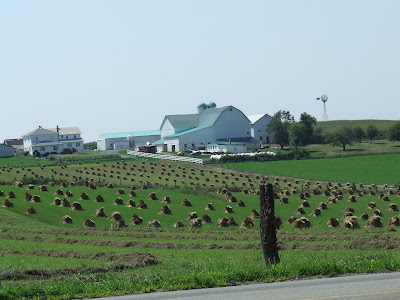
As you might expect him to, Tumbledown took special notice of the small farms (usually 100 acres or less, because the energy for their motive power comes from the sun in the form of horses), diversified farms [in the famous lines of Sir Albert Howard, An Agricultural Testament (Special Rodale Press Edition), farms with livestock and mixed crops where vegetable and animal wastes are returned to the ground to preserve fertility], and farms that are close enough to one another for the inhabitants to form well-populated, stable farming communities.


From Ohio Amish Co...

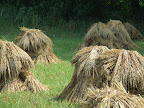
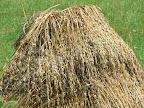
It was especially gratifying to see horse-drawn mowers and balers in the hay fields, and to see up close how shocks of wheat are left to dry before being loaded onto carts and hauled away for threshing and winnowing. To see a living, thriving community where these skills (and tools) are being used on a daily basis gives Tumbledown some hope that we, "the English," will go to school on another, more sustainable, way of working and living--and that there will be Amish sources for much-needed, newly manufactured hand tools and horse-drawn machinery when the time comes to seek them out.


From Ohio Amish Co...


From Ohio Amish Co...


From Ohio Amish Co...

Tumbledown was impressed with the selection of ingredients for cooking (this is Whole Foods, whole grains, fresh produce and the like, but without the industrialized baggage of the suburban chain store) available at the ubiquitous farm-based bulk food stores and the road-side and farm stands. But Tumbledown also noticed what most tourists to Amish Country see first, a thriving culture for the learning and producing of traditional arts and crafts, an artisans' community of hand-made household items like quilts and brooms and furniture. These are home-based "factories," in the old sense of places where things are made. Thus farmers and other "producers" live and work side by side, with gardens and barns and fields at small, irregular intervals between them.


And, of course, Tumbledown noticed all the buggy and wagon and bicycle traffic. That's what creates, even for the visitor, a slower pace to life. The refusal to own and operate cars for regular transportation is a key to the difference that we all notice as we drive our cars through Amish country. There are other keys, the lack of connection to "the grid," the limitation of education to the basics of the 8th grade, and a willingness to abide by a communal code of dress and mode of living.


But despite the attractions, nagging questions remain to be answered for Tumbledown. Can similarly sustainable communities be established and continue that exhibit a diversity of religious commitments (or no religious commitment at all) as opposed to what appears to be an Amish "religious monoculture" (or a sodality of religious monocultures)? Can a traditional community be established without hierarchical (and, specifically patriarchal) structures prevailing to the detriment of half the population? One might argue that such a community could evolve if many individuals (or nuclear families) were to choose independently to embrace such a mode of living with their own personalized rules or "orders," but it is precisely the lack of extended family and community support (and enforcement, or at least reinforcement) for such decisions and help with and provision of the models and tools for such living that are sorely lacking. Families and individuals could make these decisions perhaps, if there were communities of support already, but it seems problematic in the extreme to consider the formation of such communities where they do not already exist. Dropping out of the larger society is not exactly community formation. One can only hope (and Tumbledown does) that the ease of community-formation in cyberspace will enable us to put localized flesh-and-bones on new trial communities that aim at a new (old) way of living.


Can the community continue to outrun the pursuit of "development" and higher land prices? Can the community survive the onslaught of kitsch and commodity-fication of their own culture?


From Ohio Amish Co...

(e.g., the Guggisberg cheese factory tells its story of Amish farmers bringing their milk to the back door in buggies [?], cheese that is available at the local Indianapolis Meier store in the dairy case in the produce section. It surely came to Indy in a refrigerated diesel truck.)


From Ohio Amish Co...

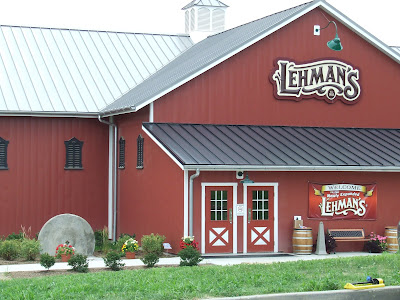
Will the Amish remain true to their values and continue their beneficial engagement with and witness to the industrial society that surrounds them? Tumbledown was somewhat dismayed to find that one of his favorite mail order catalog stores, Lehman's, was in fact playing an ambiguous role in mediating the values of the Amish (and traditional living) while at the same time very much playing up the tourist destination that it has become, restaurant and Wal-Mart mall-sized "mom-and-pop hardware store" included. Some of the products in the store were disappointing and seemed more designed for dress-up, play-time traditional rather than for the rough and tumble of real-world manual labor.


From Ohio Amish Co...

On the way home to Indy, Tumbledown stopped at the site of another "traditional" manufacture, the Longaberger basket factory and company headquarters. Again he marveled at the expensive prices on largely ornamental and nostalgia-inducing items. Can hand-crafted quality be had ever again without the boutique price and Disney-theme-park-ification? Just give me a good, strong, hand-made working basket without the smell of potpourri or the premium charged for the boutique experience. Couldn't we all use a good basket rather than the plastic carriers we've learned to hate, then break with light use, then throw away? Give me something to feel good about gathering garden produce in, something that can take some abuse outdoors and still be in use a generation or two from now. And do it without charging enough to keep this corporate monstrosity afloat.


From Ohio Amish Co...

I guess I'll be searching The Budget for an Amish basket maker in Indiana, someone whose workshop is steps from home, and garden, and barn.


Tumbledown would be remiss if he were to close the post without thanking his hosts, Dan and Nancy Lembke, program directors for A Valley View Inn, part of the Pastors Retreat Network. If you know a pastor who could use a week of spiritual renewal in Amish country, point the pastor and spouse to www.pastorsretreatnetwork.org. The stay is free for pastors (and spouses) in full time Christian ministry. The food is great (and Amish) and the leaders wonderfully down to earth (but also also spiritually minded). The library of Christian resources for ministry is strong and well focused for a week of retreat. Do your pastor and your congregation a favor by telling your pastor about this opportunity for spiritual rest and renewal.


From Ohio Amish Co...

Tumbledown Farm

Thursday, July 12, 2007

Missouri Day Trip: Agricultural Museum

Tumbledown did far too much traveling and far too little gardening this summer. Two of those trips took him home to Northwest Tennessee via Southern Illinois and Southeast Missouri. On one of those trips he was fortunate enough to discover the Southeast Missouri Agricultural Museum in Bertrand, Missouri (Southeast Missouri Bootheel, just north of New Madrid and east of Sikeston).


Sign Advertising SEMO Agricultural Museum


The museum is conveniently located near the intersection of I-57 and I-55.


horse-drawn plows, SEMO agricultural museum


Though much of the machinery in the building is poorly labeled, poorly sorted, and unrestored--and none appears to be used even for demonstration purposes--the display is well worth the modest price of admission ($5 per person) for the antique farm machinery enthusiast. The importance of the collection has also come to the attention of the National Park Service, as the listing in the Draft Heritage Study demonstrates.


horse-drawn spring-tooth hay rake, antique farm equipmentÂ


Tumbledown hopes that the collection will be made available to persons who are interested in studying, copying and restoring these valuable parts of our heritage and for use at working "living history" farms and demonstration projects.


antique John Deere tractor, SEMO Agricultural Museum


Address:

Route 1, Box 875

Bertrand, MO 63823


horse-drawn plow, SEMO Agricultural Museum


Phone: (573) 471-3945


Hours:

9-4 Mon.-Sat.

1-4 Sun.


horse-drawn shovel plow, SEMO agricultural museum


The owners boast that they have under one roof "Missouri's largest agricultural museum with over 6,000 pieces of antique farm machinery," in addition to the grounds, where visitors will find two log cabins, one wooden railroad caboose, and a relocated railroad depot.


horse-drawn cultivator, SEMO agricultural museum


steam driven antique thresher tractor


Readers interested in finding out more about now-antique farm machinery when it was "state of the art," can view sketches and descriptions in the article on crop management in the Cyclopedia of American Agriculture. Those readers interested in commercial collectors' information about vintage farm equipment, see the Farm Collector.


antique, horse-drawn seeder


Tumbledown Farm

Wednesday, July 4, 2007

Ecology, Economics, Ethics: The Broken Circle

F. Herbert Bormann and Stephen R. Kellert, eds. Ecology, Economics, Ethics: The Broken Circle. Yale University Press: New Haven and London, 1991.


In addition to the dated references in a work now 16 years old, this book suffers from the usual shortcomings of academic essay collections. The essays are disconnected and poorly coordinated, being loosely arranged around the three-part theme of ecology, economics, and ethics. The essays are uneven in quality and accessibility; in other words, the book wants the professional editing to be a book. Though most of the authors are notables in the area of ecology and environmental science, few are as well versed in either economics or ethics, so the treatment is often highly technical in its arguments in one of the three areas, but bedeviled by generalities and unfounded assertions in the next. The essays range over a broad swath of issues related to environmental conservation, from biocide (the human-caused mass extinction of thousands of species; the "death of birth") to proposals for financing conservation in five sections: Species Diversity and Extinction, Modern Agriculture, Environmental Values, Pollution and Waste, and Market Mechanisms.

So, why is Tumbledown reviewing the book? First, because a few of the essays are by themselves worth the price of admission. Among these are the essays by Wes Jackson ("Nature as the Measure for a Sustainable Agriculture"; author, Becoming Native to This Place) and David Pimentel ("The Dimensions of the Pesticide Question"; author, CRC Handbook of Pest Management in Agriculture, Second Edition, Volume I). The opening essay, on biodiversity, by Edward O. Wilson (author, The Creation: An Appeal to Save Life on Earth) also falls into this category, as does Paul H. Connett's "The Disposable Society." The latter, along with sections of the essays on groundwater and wind, had Tumbledown asking whether the next person who unknowingly throws away a flashlight battery be prosecuted for crimes against humanity. (Or is that "crimes against biology"?) Many of the concerns that were front and center in the late 80's have now faded from the public eye (e.g., the landfill crisis and acid rain). That doesn't mean that they have faded from importance. Others have become more glamorous (e.g., global warming, via Al Gore's "An Inconvenient Truth"). This pattern of awareness and response is actually graphed in the essay by Gene Likens (p. 142; author, Long-Term Studies in Ecology: Approaches and Alternatives). Second, Tumbledown would like to see several of the essays updated. Connett's essay on "The Disposable Society," for example, provides model examples of local community and civic initiatives for reuse and repair (reusables), toxic waste exchange (toxics), composting (compostables), separation and upgrading (recyclables), and screening of mixed waste for landfills (the rest). What is the status 16 years later of these model programs? Tumbledown wonders. And are the only effective responses those devised by governments and civic organizations? In Tumbledown's humble opinion all is lost if the response is dependent on governmental action and the will of our political leaders. So is there a place for individual action by those who are convinced of the need to live according to St. Francis of Assisi's way of voluntary poverty? Is there room for "freegans" (dumpster divers) who strive to reduce their "carbon footprint," coordinating their efforts in informal, internet-based communities? Have we eliminated non-reusable packaging yet? (Of course not.) In other words, it would be helpful to have an update of the status quaestionis of this academic debate and another list of best practices and bibliography of works published on this topic in the intervening years.

Still, if you can find it, this book is worth the read. It isn't quick or easy going, but it is definitely provocative.

Saturday, June 30, 2007

Honeybee Update: Pesticides

We arrive at the end of June and Tumbledown has not seen more than a few honeybees in the garden--and those only on a couple of different occasions this whole season--despite continuing efforts to attract them with sugar-water syrup, honey, and swarm catch attractors--and despite the constant provision of fresh water and flowering plants. The blackberry and raspberry blooms, which are hardly ever absent a honeybee in an average year, have hardly been visited at all in 2007.


You have no doubt followed the various news updates of the investigation into Colony Collapse Disorder (CCD), the results of which (for now) seem to point increasingly toward a complex syndrom rather than a single factor, chemical, pathogen, pest or otherwise. The use of pesticides is often cited as a contributor to the CCD syndrom, especially pesticides in the Neonicotinoid class. Bayer and other producers deny (of course) that their products are the cause, even a contributing cause, and claim that nonchemical causes are to blame.


Maybe the causes of CCD are nonchemical, but the question still remains, why are we addicted to pesticides?--especially when the current chemical regime has proven ineffective? Tumbledown has been reading an essay by David Pimentel ("The Pesticide Question," Ecology, Economics, Ethics) that makes the point: "Corn and cotton account for about 60 percent of the total insecticide use in agriculture" (1991). For Indiana, make that corn, almost exclusively. "During the 1940s, little or no insecticide was applied to corn, and crop losses to insects were only 3.5 percent.... Since then insecticide use on corn has grown more than a thousandfold, and losses due to insects have increased to 12 percent." The major reason for the increase seems to be the abandonment of an important (vital?) aspect of traditional farming, crop rotation (p. 64).


What does this have to do with Colony Collapse Disorder and the bee die off? Maybe nothing. But in the concluding table, Pimentel estimates the unintended cost of pesticide use at $955 million (1980), $150 million of that due to honeybee poisonings and reduced pollination. Hmmm. Maybe that should be increased a thousand fold this year?


Meanwhile, with no chance of a swarm on the horizon, Tumbledown has decided to buy his bees next year. Maybe they'll survive the pesticides poured onto the fields that lie just beyond the suburban sprawl--and survive the pesticides poured onto suburban lawns. ...or maybe they'll suffer from Colony Collapse Disorder, even though he plans to keep them according to the ancient instructions of Varro (On Agriculture, III, XVI). Tumbledown recently discovered a blog that suggested CCD may be nothing new and appears in fact to have plagued the ancient Romans, based on a description of ancient hive disruptions found in Virgil's Georgics. Or maybe it is entirely new--a twenty-first century problem; maybe all those cell phone signals are playing the Pied Piper to our honeybees. If that's the case, Tumbledown's bees should fare well. He doesn't own a cell phone.


Tumbledown Farm